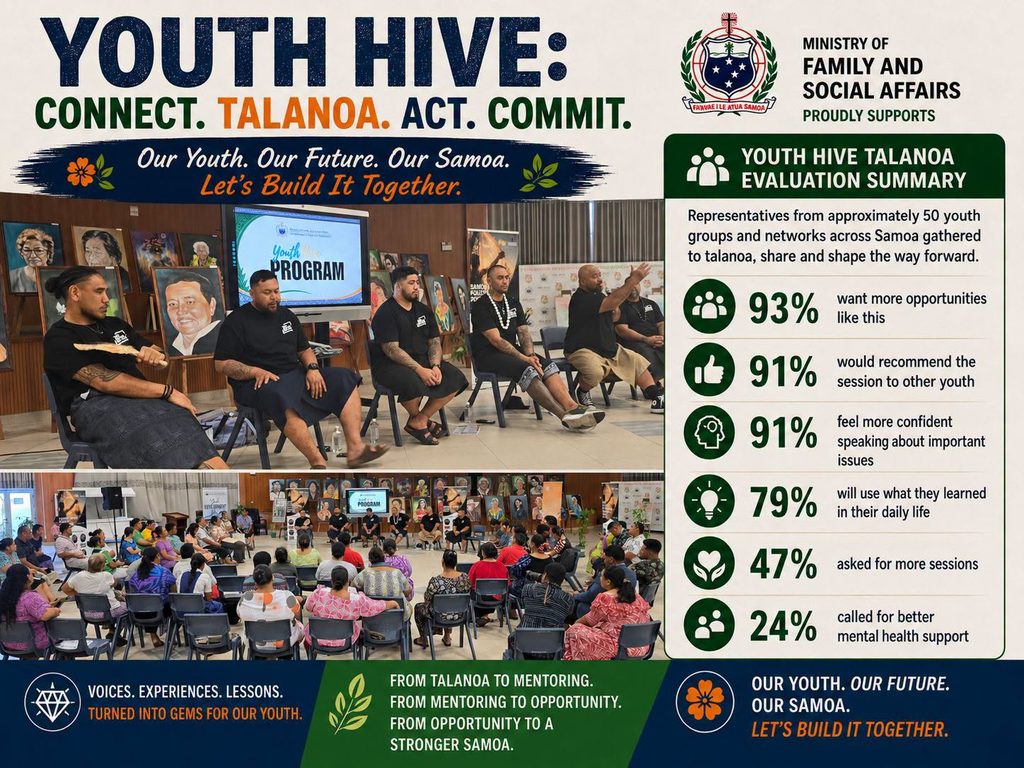
And what emerged was much bigger than an afternoon of talanoa.
The evaluation tells us that young people want more opportunities, more practical engagement, stronger mental-health support, mentoring and people who will continue walking alongside them.
That is why the Return to Paradise delegation was so important.
A remarkable collection of lived experience, professional expertise, community service and hard-earned life lessons — people prepared to take the successes, disappointments, pressures, wrong turns, setbacks and lessons from their own journeys and turn them into gems for the next generation.
At the centre was Detective Sergeant Tuala Tamalelagi Ben Tuala-Tamalelagi Ben Neli Sega, Chair and founder of the Pacific Officers Law Enforcement Network — POLEN.
POLEN was established after he saw the very real consequences of young Pasifika becoming vulnerable to organised crime. His response was not simply enforcement. It was to build relationships between police and Pasifika communities, strengthen cultural understanding and reach young people differently.
That experience matters enormously for Samoa.
Because prevention has to begin before a young person reaches crisis, the justice system or the point where choices become much harder to reverse.
Alongside him was an extraordinary depth of community experience:
Joe Tau — One Love Mentoring — bringing years of practical youth work and mentoring, including programmes built around identity, confidence, relationships, trust and young people taking ownership of their own futures.
Francis Nansen — The Village — bringing the power of culture, community connection and working with young people in ways that allow them to feel seen, understood and able to participate.
Jesse Sene-Lefao — Talk Your Walk Foundation — former Toa Samoa international and now mentor and youth-development practitioner, taking the lessons of elite sport, setbacks, resilience, identity and mental wellbeing and using them to create safe spaces where young people can talk, grow and find another way forward.
Frank Winterstein — former Toa Samoa player, NRL Ambassador — bringing the perspective of professional sport, family, purpose, leadership and life beyond the stadium.
And To’alepai Eronny Mareko — helping turn conversation into action through facilitation, team-building, leadership and challenging young people not simply to listen, but to decide what they themselves can do next.
What made the afternoon powerful was not perfection.
It was honesty.
Young people heard that success is rarely a straight road.
They heard about pressure. Choices. Failure. Reinvention. Discipline. Family. Faith. Responsibility. Mental wellbeing. Giving back.
And they heard from people who could say:
“I have walked some of this road too.”
That opens something a lecture cannot.
It opens trust.
It opens conversation.
It opens the possibility that a young person who may never walk into a counselling office, speak to a government officer or admit they are struggling might first speak to a mentor they identify with and trust.
And that is where the Youth Hive data becomes strategically important.
93% want more opportunities like this.
91% would recommend it to another young person.
91% felt more confident speaking about important issues.
79% said they would use what they learned in daily life.
When asked what Samoa needs next, young people identified better youth opportunities, mental-health support, employment and entrepreneurship, life skills, leadership and practical activities.
They are telling us clearly:
DON’T JUST GIVE US A SESSION. BUILD THE SUPPORT AROUND US.
This presents a very real opportunity for Government and our development partners.
Samoa can take the expertise brought by the Return to Paradise delegation and use it not as a one-off visit, but as the beginning of a much deeper investment:
A national youth mentoring and early-intervention model.
A model that trains Samoan mentors and youth workers.
A model connecting youth organisations, families, churches, sport, schools, community leaders, Police, health services, counsellors and specialist support.
A model where a young person does not have to be in serious trouble before somebody notices them.
And critically, a model that deliberately includes young women and men, young people with disabilities, unemployed youth, young people outside education and those facing circumstances that place them at greater risk of exclusion.
The aim is not to import a programme.
It is to learn from proven experience, build Samoa’s own capability and leave that capability here.
That is the investment opportunity.
Mentor the mentors.
Train the youth workers.
Strengthen counselling and referral pathways.
Create safe spaces.
Build practical skills.
Connect young people to opportunity.
And reach them early.
From lived experience to shared wisdom.
From talanoa to trust.
From trust to mentoring.
From mentoring to early intervention.
From early intervention to opportunity.
That is how we turn individual stories into national capability.
And that is why investing in Samoa’s young people today is not optional.
It is prevention.
It is protection.
It is development.
And it is an investment in the future of Samoa.